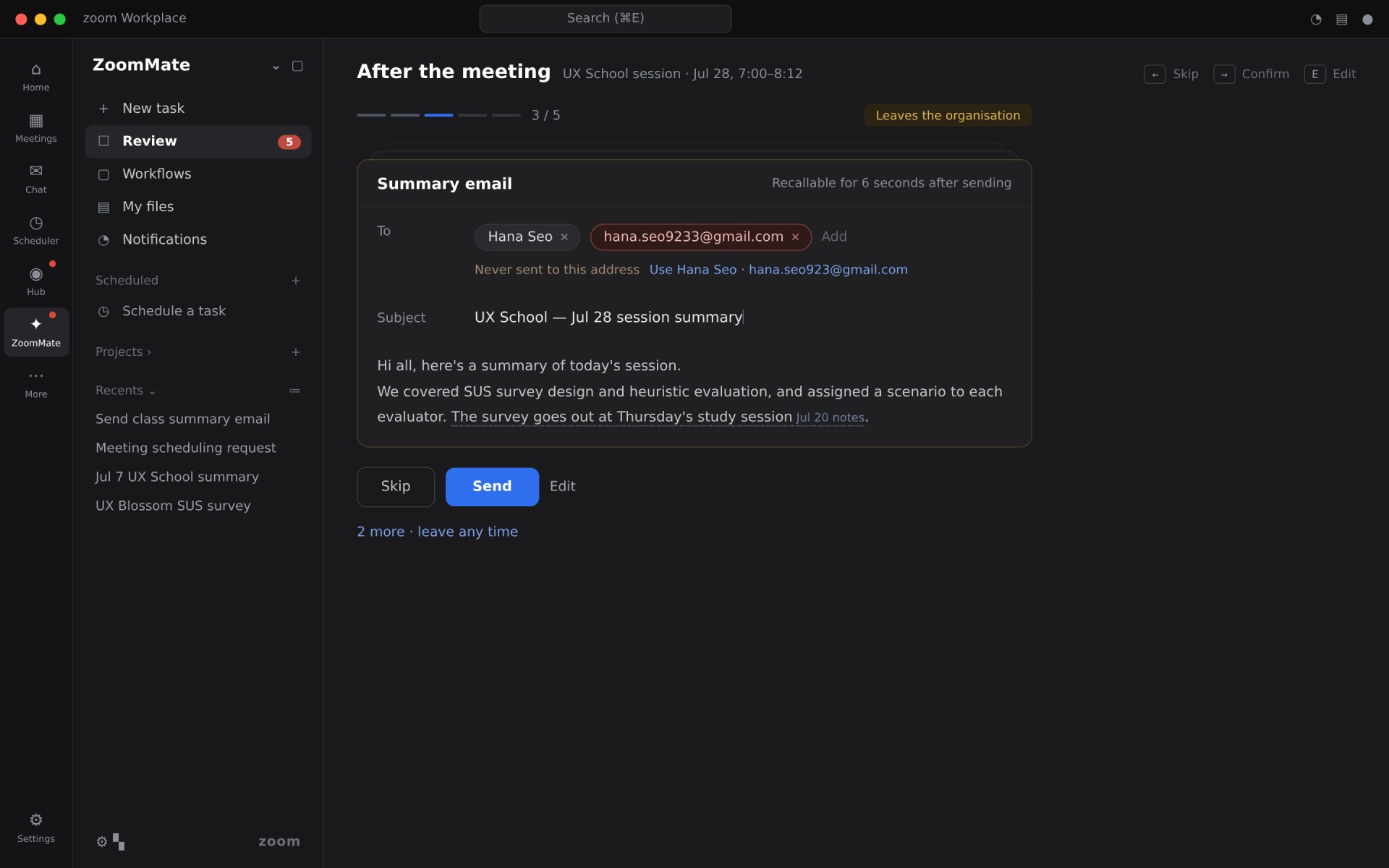
AI can create the work. People still need to trust the next step.
After a meeting, Zoommate drafts emails, documents and invites. The risk starts when that content becomes an action that affects other people. This exploration helps people review and correct AI actions before they run, without making automation another chore.
Evaluate both usability and the boundaries of AI control.
- Heuristic evaluation, 10 + 4 AI criteria
- Team of 7 evaluators
- Journey mapping
- Design personas
Zoommate had launched only about a month earlier, so recruiting real users was hard. Seven of us, including me, ran a heuristic evaluation instead, each filling in our own sheet.
Nielsen’s 10 usability heuristics assume a system does what a person tells it to. Zoommate decides and acts on outside systems by itself, so we added four AI criteria from Google’s People + AI Guidebook: transparency, reversibility, calibrated trust, and permission and control boundaries.
We evaluated email sending, document creation and meeting scheduling. Three issues came up most, each with nine negative mentions across our sheets: error prevention, error recognition and recovery, and reversibility.
Approval is not the same as verification
In the email approval step, we found no clear preview of recipient, subject and content. Giving permission to act does not necessarily mean the user has verified the action itself.
Ambiguous inputs need clarification
We saw the system interpret “tomorrow 8” without first resolving ambiguity. Time and timezone changes then required further correction.
Recovery needs an understandable path
Technical error messages and unclear cancellation or recovery options leave users uncertain about what happened and what they can do next.
Reduce uncertainty without adding another review burden.
Add confirmation before AI actions are executed.
Make verification focused and efficient, so people do not repeatedly check the same information across separate steps.
Permission, content verification and the consequences of an action need to be understandable together. Not every action has the same risk, or the same ability to be undone.
Find the moments where confidence drops.
What the map revealed
Source referencesShow where a generated action came from.
Inline editingFix details where they appear, not in a separate step.
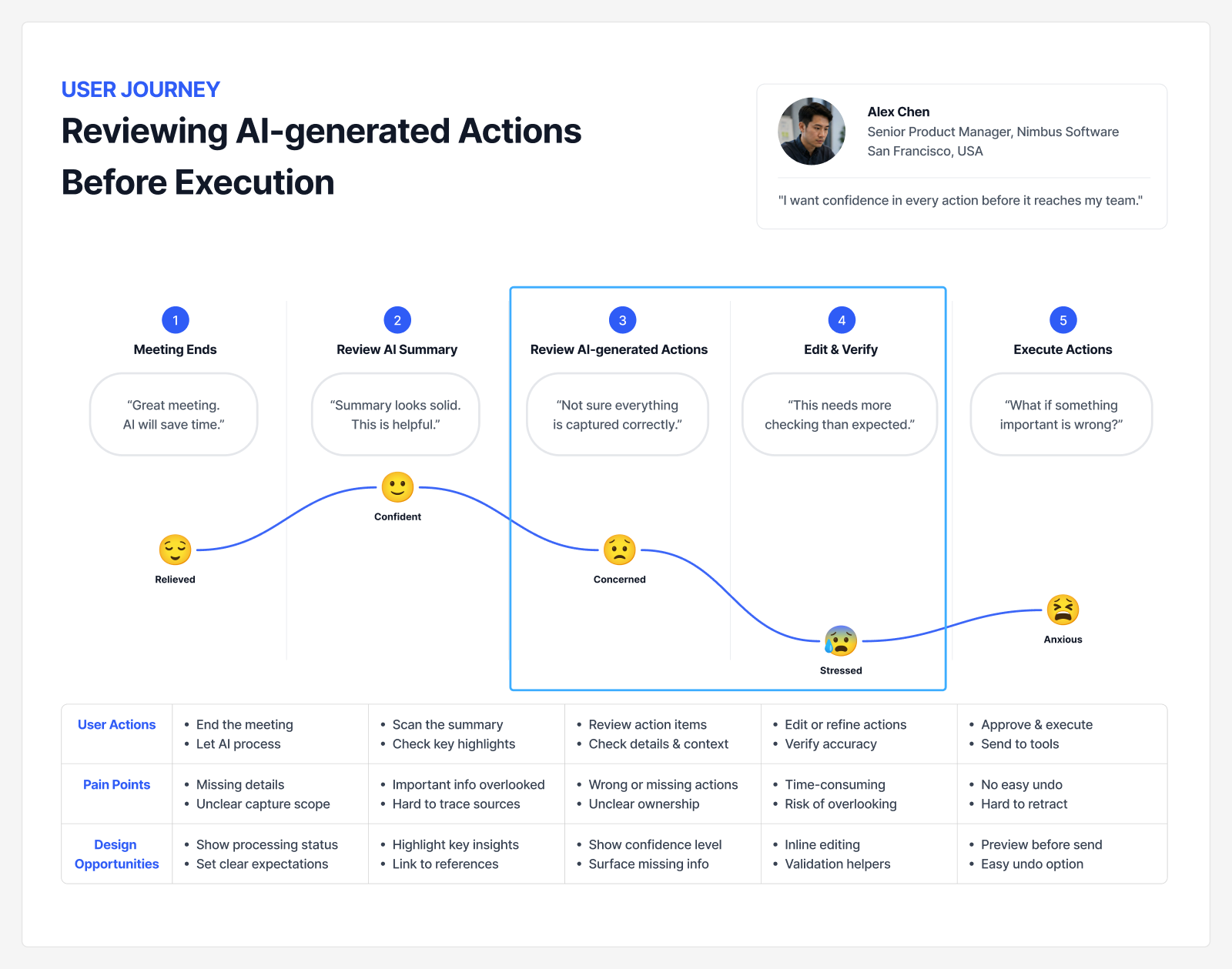
ValidationResolve ambiguous inputs like “tomorrow 8” before acting.
Action previewsSee recipient, subject and content before approving.
Alex is a design persona, so this map is a synthesis, not a participant record. Confidence falls as Alex moves from reading a useful summary to checking and correcting generated actions. That drop points to four opportunities: source references, inline editing, validation and clearer action previews.
Give people the right control at the right moment.
I designed a review flow that turns the four directions into one sequence: Zoommate gathers what it drafted after a meeting, and the person checks each action before it runs. These are design concepts, not validated or shipped features.
The review flow
1. Review queue
Later stays safeSkipping keeps items in Review instead of running them.
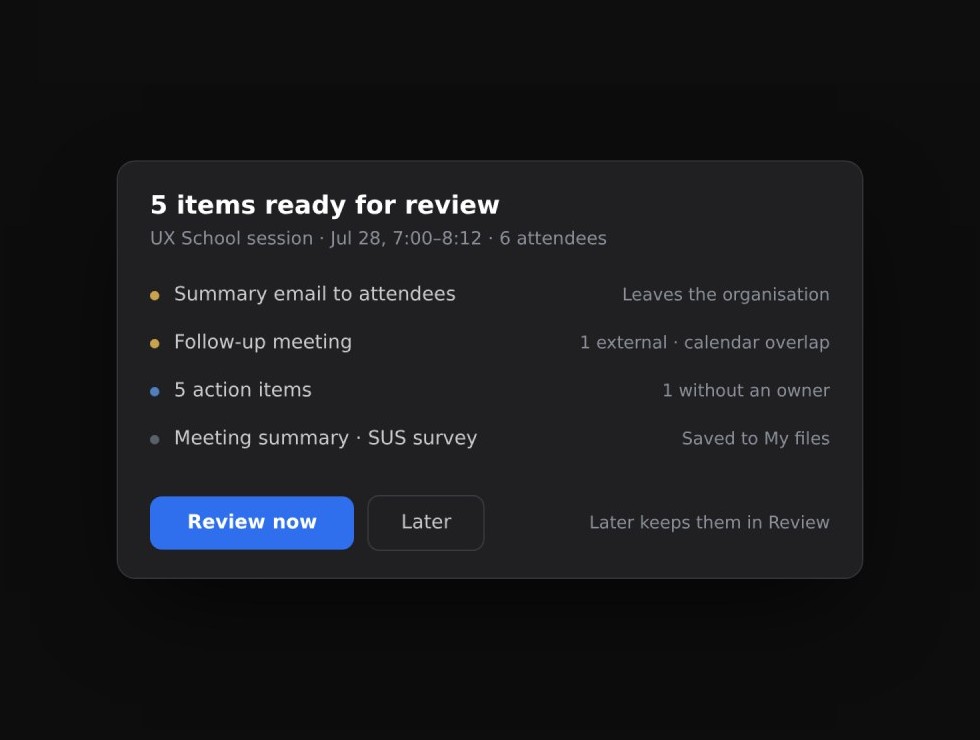
Risk up frontEach item names what could go wrong before review starts.
2. Summary email
Check the recipientAn address never used before is flagged, with the known contact suggested.
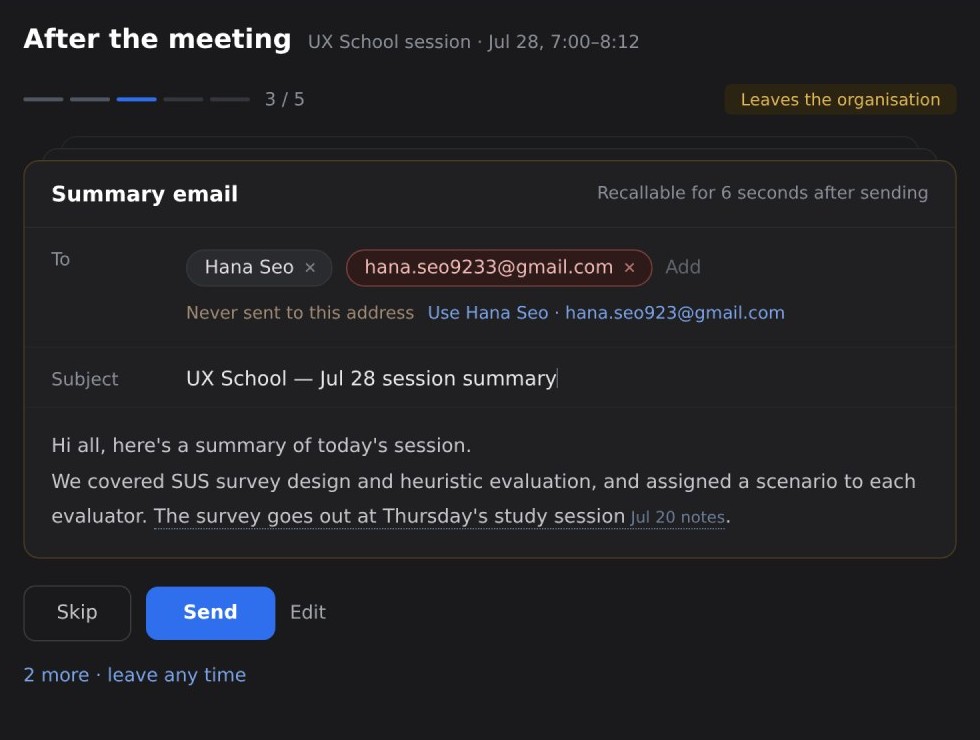
A short way backA sent email can be recalled for six seconds.
3. Follow-up meeting
Ambiguity made visible“Thursday around 8” becomes an AM or PM choice, with the meeting quote shown.
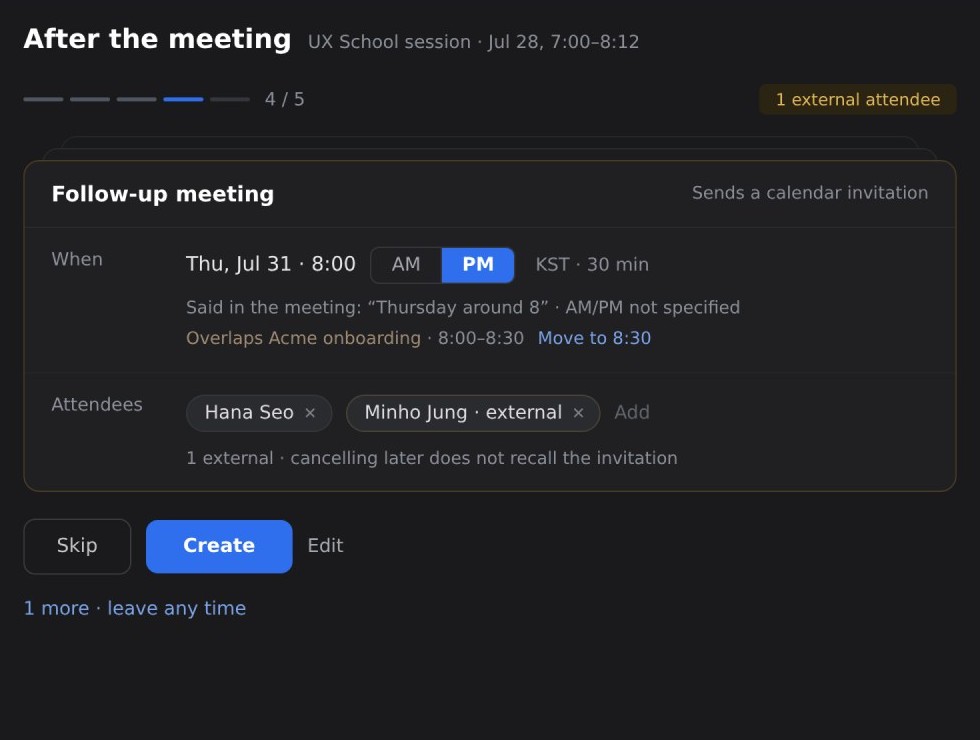
Consequences statedInviting an external attendee cannot be recalled later.
4. Action items
Approve selectivelyCreate the four ready items, or assign the fifth first.
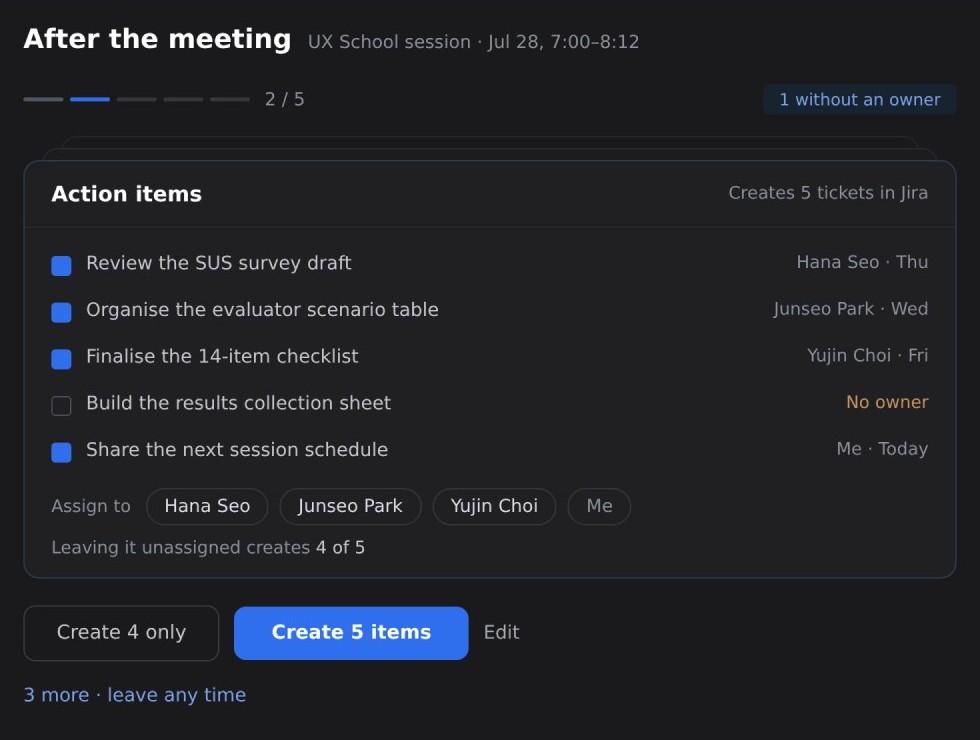
Nothing hiddenOverlaps and missing owners appear where the decision is made.
Review with context
Preview the action and expose relevant sources, missing information and conflicts.
Edit before execution
Keep corrections close to the content, with inline editing and the option to save a draft.
Approve selectively
Explain what will happen, distinguish higher-risk external actions, and let people choose which actions to execute.
Make recovery explicit
Show execution status and the available recovery options. Do not promise that every external action can be undone.
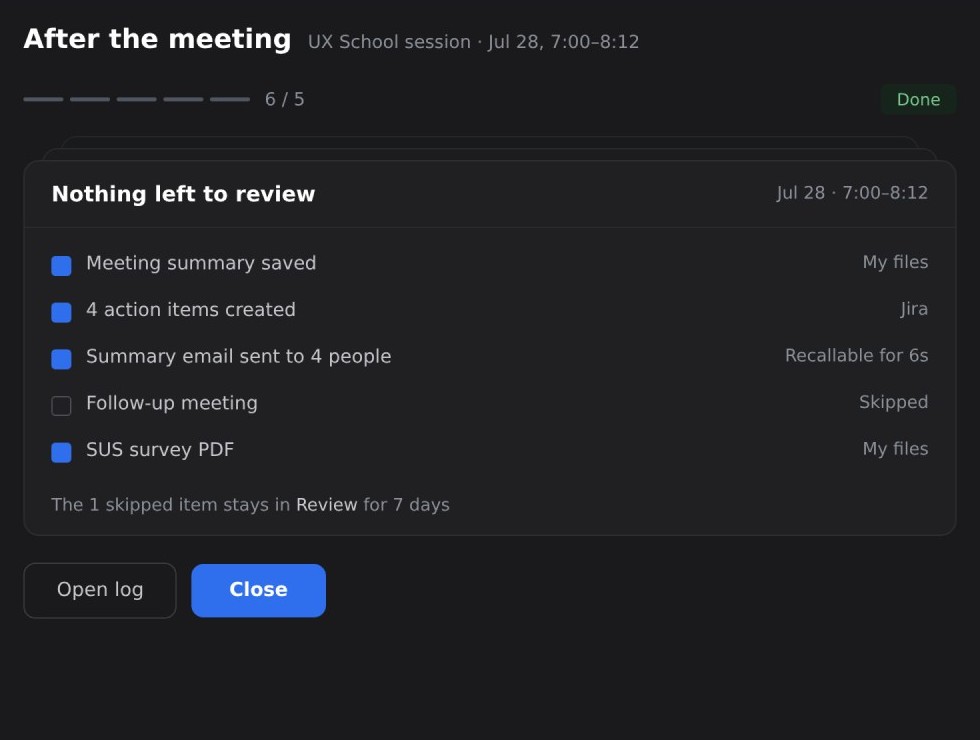
Test confidence and effort together.
The next step is to test whether the proposed review flow helps people notice errors while reducing repeated checking. We prepared interview and usability-testing plans but have not run them, so this page reports no user results.
Success would need evidence about both error detection and review effort, not simply more confirmation screens.